Most families do not suddenly decide one day that Mom or Dad needs 24-hour care.
Usually, it happens gradually.
Maybe your mom has fallen a couple of times. Your dad is getting up several times during the night. A parent who used to be fine alone is becoming confused, forgetting meals, or needing more help getting around the house.
At some point, families start asking an important question: Is it still safe for them to be alone?
Here are some signs that it may be time to consider 24-hour home care.
1. They Are Falling or Having Trouble Getting Around
Falls are one of the biggest concerns for older adults living at home.
Getting out of bed, walking to the bathroom, standing up from a chair, or stepping into the shower can become difficult.
Nighttime can be especially risky. Someone may be tired, disoriented, or trying to walk through a dark house without help.
If your parent regularly needs someone nearby to walk safely or move from one place to another, a few hours of care during the day may no longer be enough.
2. They Are No Longer Safe Home Alone
Sometimes the warning signs are small at first.
You might notice your parent leaving the stove on, forgetting to lock the door, missing meals, becoming confused about the time of day, or having trouble using the phone.
One incident does not necessarily mean someone needs 24-hour care.
But when several things begin happening regularly, it may be time to look more closely at whether that person can still safely be alone for long periods.
3. Dementia or Nighttime Confusion Is Getting Worse
Dementia can make evenings and nighttime especially difficult.
Someone may wake up confused, wander through the house, try to leave the home, or not remember where they are.
Having a caregiver present can provide supervision, reassurance, and help with normal routines.
It can also take some of the pressure off a spouse or adult child who has been trying to stay available around the clock.
4. They Need Help During the Night
Care needs do not always stop at bedtime.
Your parent may need help getting to the bathroom, getting in and out of bed, changing clothes, getting a drink, or simply finding their way safely through the house.
When someone needs assistance several times during the night, family members often start losing sleep too.
That can be a sign that additional help is needed.
5. Personal Care Is Becoming More Difficult
Bathing, dressing, grooming, toileting, and moving around the home may gradually become harder.
At first, your parent may only need help in the morning.
Later, they may need assistance several times during the day and again at night.
When those needs become more frequent, having someone available around the clock may make the home safer and the daily routine easier.
6. They Have Just Come Home From the Hospital or Rehabilitation
Sometimes 24-hour care is only needed temporarily.
After a hospital stay, surgery, illness, or rehabilitation, someone who was previously fairly independent may suddenly need much more help.
A caregiver can assist with meals, bathing, dressing, walking, transportation, household tasks, and getting to follow-up appointments.
As the person becomes stronger, the amount of care can often be reduced.
7. The Family Is Already Providing Care Around the Clock
This one is easy to overlook.
Maybe someone is sleeping at Mom’s house every night. Siblings are rotating days. A spouse is afraid to leave the house. Family members are missing work or constantly checking their phones.
At that point, the family may already be providing around-the-clock care without calling it that.
Bringing in professional caregivers can give family members a chance to sleep, work, take care of their own families, and spend time with their parent without always being the caregiver.
8. Several Problems Are Happening at Once
There usually is not one single event that tells a family it is time for 24-hour care.
It is often a combination of things.
Maybe your mother has fallen twice, needs help getting to the bathroom at night, is becoming more confused, and no one feels comfortable leaving her alone.
Individually, each issue may seem manageable.
Together, they may be telling you that she needs more support.
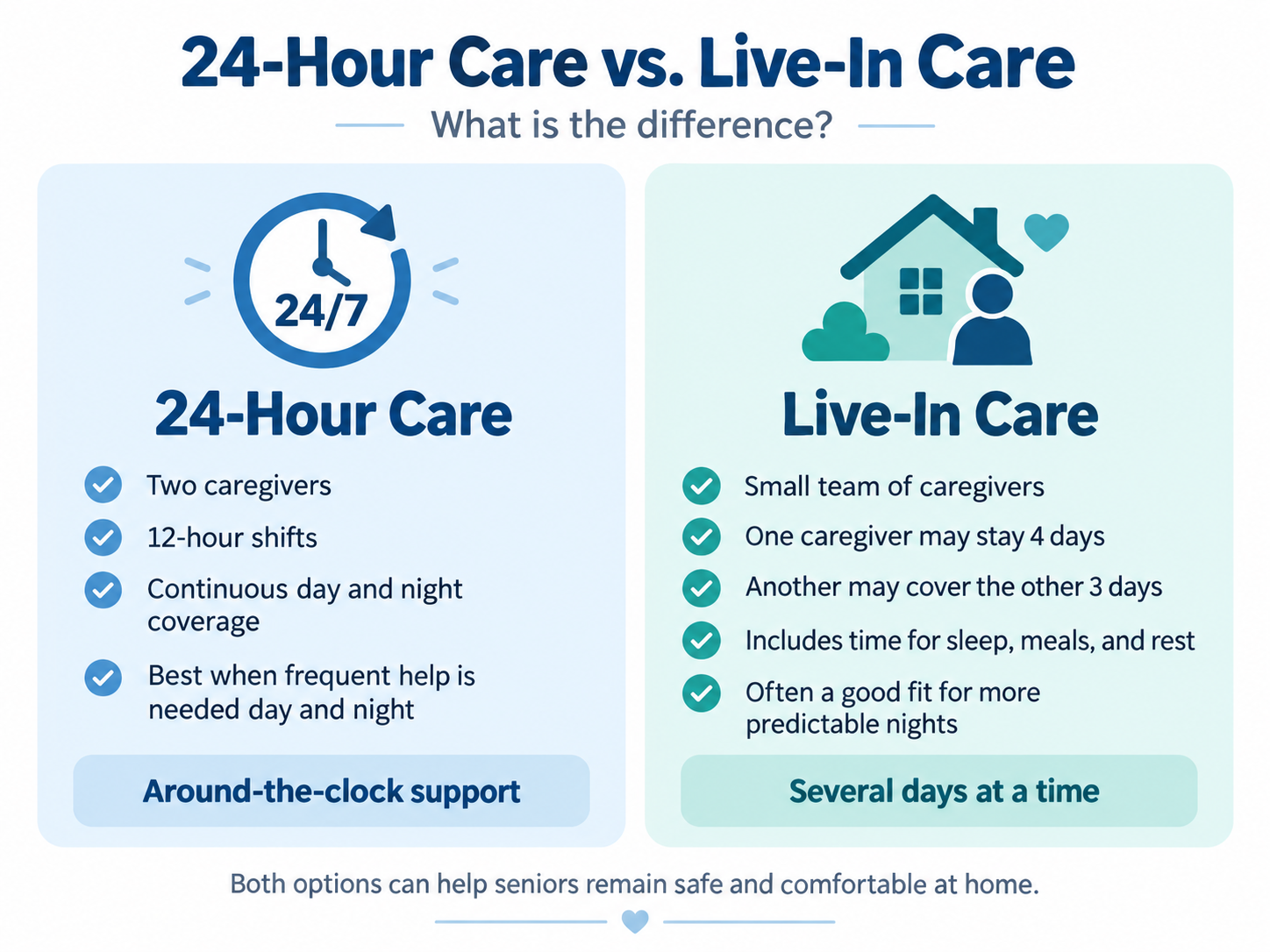
What Is the Difference Between 24-Hour Home Care and Live-In Care?
Families often use the terms 24-hour care and live-in care as though they mean the same thing, but there is an important difference.
With 24-hour care, coverage is typically divided between two caregivers working 12-hour shifts. One caregiver covers part of the day, and another caregiver takes over for the next shift. This provides continuous caregiver coverage throughout the full 24 hours.
Live-in care works differently.
With live-in care, a small team of caregivers rotates staying in the home for several days at a time. For example, one caregiver may stay for four days and another caregiver may cover the remaining three days of the week.
Because the caregiver is living in the home during that time, the schedule includes designated periods for sleep, meals, and rest.
Live-in care can be a good option for someone who needs a significant amount of help during the day but generally has a more predictable nighttime routine.
Twenty-four-hour care may make more sense when someone needs frequent assistance or supervision during both the day and night.
Every situation is different, which is why it is important to look at what is actually happening in the home before deciding which type of care is appropriate.
What Can a 24-Hour Caregiver Help With?
Comfort Caregivers provides non-medical assistance with everyday needs such as:
- Bathing and grooming
- Dressing
- Toileting and incontinence care
- Walking and transfers
- Fall-risk supervision
- Meal preparation
- Light housekeeping
- Medication reminders
- Companionship
- Transportation and errands
- Morning and evening routines
- Overnight assistance and supervision
The goal is not to take away someone’s independence. It is to provide enough help so they can continue doing as much as possible safely.
Does Needing 24-Hour Care Mean Someone Has to Move?
Not necessarily.
In fact, one of the reasons families choose 24-hour home care is because their parent wants to remain at home.
For many older adults, familiar surroundings, their own bedroom, their pets, neighbors, and normal routines are very important.
The question is whether the person’s needs can still be safely met at home with the right amount of support.
Not Everyone Needs 24-Hour Care
Sometimes families call thinking they need round-the-clock help when a smaller schedule may work perfectly well.
Someone might only need help in the mornings and evenings. Another person may need overnight assistance. Someone recovering from surgery may need 24-hour care for a short period and then gradually need less.
There is no reason to arrange more care than someone actually needs.
The right schedule should be based on the individual and what is happening in the home.
Wondering What Your Parent Needs?
If you are beginning to wonder whether Mom or Dad is safe alone, that is usually a good time to have a conversation.
You do not need to know whether you need four hours of care, overnight help, live-in care, or 24-hour coverage before calling us. That is something we can talk through with you.
Comfort Caregivers provides non-medical home care in Scottsdale and throughout Maricopa County.
We can learn a little about what is happening at home, answer your questions, and help you determine what type of care may make the most sense for your family.
Call Comfort Caregivers at (602) 482-7777 to talk about your family’s situation, or learn more about our 24/7 Hourly Care and Supervision services.