
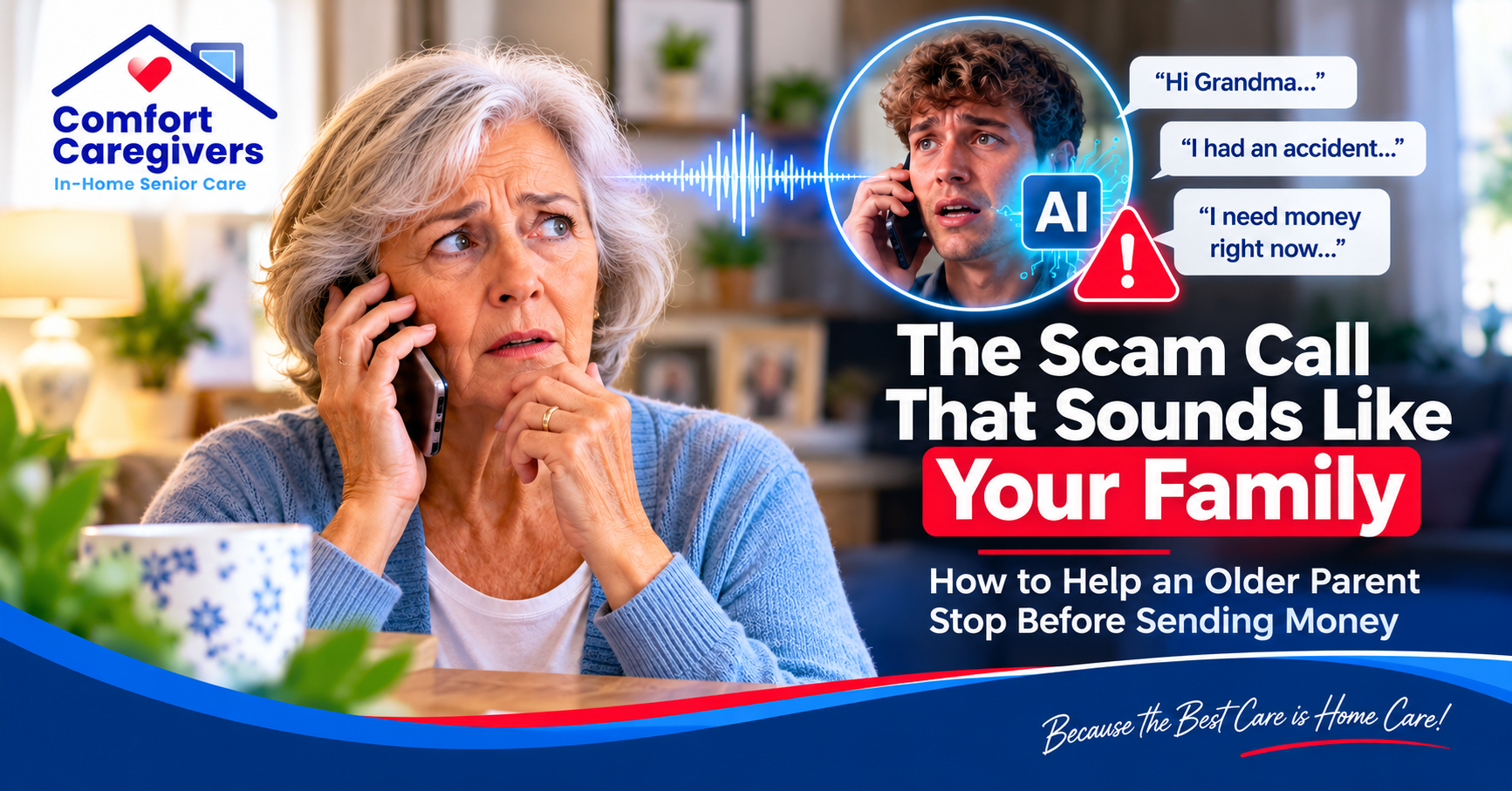
Imagine your phone rings and the voice on the other end sounds exactly like your grandson.
He’s upset. There’s been an accident. He needs money right away, and he begs you not to call his parents.
There was a time when hearing a familiar voice might have been reassuring. Not anymore.
Artificial intelligence can now help scammers imitate a person’s voice from a surprisingly small audio sample. Add caller-ID spoofing, information gathered from social media, and a convincing story, and a scam can feel frighteningly real.
For families with an older parent living independently, that’s worth talking about. Not because Mom or Dad can’t be trusted, but because the scams themselves have changed.
Senior scams are becoming harder to recognize
The old warning signs haven’t disappeared. There are still fake sweepstakes, romance scams, bogus charities, government impostors and callers pretending to be from Medicare or a bank.
What’s changed is how convincing some of them can be.
A scammer may know a family member’s name. The phone number on caller ID may look legitimate. A text message may appear to come from a bank. An email may look almost identical to one from a company your parent actually uses.
And increasingly, technology can make a fake emergency sound like a real one.
According to the FBI’s Internet Crime Complaint Center, Americans age 60 and older filed more than 201,000 complaints in 2025 and reported more than $7.7 billion in losses. That’s a dramatic increase from the previous year, and the FBI continues to warn families about increasingly sophisticated impersonation, phishing, cryptocurrency and other scams targeting older adults.
That last part matters.
The most useful defense may not be learning to recognize every new scam. It may be learning to stop before acting.
Create a family rule: stop, hang up and verify
Families don’t need to turn Mom’s kitchen table into a cybersecurity command center.
A much simpler rule can help:
If someone unexpectedly asks for money, financial information, gift cards, cryptocurrency, a password or a verification code, stop the conversation and verify the request another way.
That means hanging up and calling the person, bank, government agency or company using a number you already know or obtain independently.
Don’t use the phone number supplied by the caller.
Don’t click the link in the unexpected text message.
And don’t let an artificial deadline make the decision for you.
“Don’t tell anyone” should immediately raise suspicion
One of the most effective scam tactics has nothing to do with technology. It’s isolation.
A supposed grandchild says, “Please don’t tell Mom.”
A caller claiming to represent the government says discussing the matter could interfere with an investigation.
A new online romantic interest says other family members simply wouldn’t understand.
Those instructions are designed to prevent the person from doing the one thing most likely to expose the scam: talking to somebody else.
A useful family agreement is simple: no legitimate emergency is too urgent to verify with another trusted person.
Consider creating a family safe word
Families can also agree on a word or phrase that isn’t posted online and would be difficult for a stranger to guess.
If someone calls claiming to be a child or grandchild with an emergency, ask for the family safe word.
It’s not foolproof, and it shouldn’t replace independently calling the family member, but it creates another hurdle for an impersonator.
Just make sure everyone understands the rule: don’t text the safe word casually, don’t post it online and don’t give it to someone who calls asking for it.
Watch for payment methods designed to stop you from getting your money back
The story may change, but the requested payment method often tells you a lot.
Be especially suspicious when someone insists on payment through:
- Gift cards
- Cryptocurrency
- A Bitcoin or cryptocurrency ATM
- Wire transfers
- Cash sent by courier or mail
- Payment apps to an unfamiliar person
Government agencies and legitimate businesses don’t suddenly demand that you rush to a store, buy gift cards and read the numbers over the telephone.
If the instructions sound unusual, stop.
Medicare season can bring another round of impostors
Fall is an especially good time to have this conversation because Medicare Open Enrollment runs from October 15 through December 7 each year.
During this period, older adults may legitimately receive more mail, advertisements and calls concerning Medicare plans. That can make it harder to distinguish legitimate marketing from someone attempting to obtain a Medicare number or other personal information.
Medicare advises beneficiaries to guard their Medicare number like a credit card and be cautious about unsolicited requests for personal information.
If there’s any doubt, beneficiaries can contact Medicare directly at 1-800-MEDICARE (1-800-633-4227) or visit the official Medicare website rather than relying on contact information supplied by an unexpected caller.
Don’t make embarrassment part of the scam
This may be the most important family conversation of all.
If a parent falls for a scam, getting angry or saying, “How could you believe that?” can make the next scam more dangerous.
Smart, capable people get fooled.
These schemes are deliberately designed to create fear, urgency, affection, confusion or authority. Some are operated by organized criminal groups that test and refine their tactics over and over again.
Make sure Mom or Dad knows that if something feels wrong, they can call you without being judged, even if they’ve already sent money or shared information.
The sooner someone speaks up, the better the chance of limiting additional damage.
A five-minute family scam plan
You don’t need a complicated system. Sit down with your parent and agree on a few rules:
- Unexpected request for money? Stop and call someone you trust.
- Family emergency? Hang up and call the family member directly.
- Bank problem? Call the number printed on the bank card or statement.
- Medicare question? Contact Medicare through its official website or phone number.
- Asked for gift cards or cryptocurrency? Don’t pay until you’ve independently verified the request.
- Someone says to keep the situation secret? Tell another trusted person immediately.
It can also help to keep a short list of trusted contacts near the telephone or somewhere easy to find.
Sometimes the warning sign isn’t the scam itself
If you notice unusual purchases, repeated calls from strangers or your parent becoming overwhelmed by suspicious messages, it may be time for a little extra support.
Start with a conversation. Make sure Mom or Dad knows they can always turn to you without embarrassment, even if they’ve already fallen for a scam.
Trusted resources
- FBI: Elder Fraud and Common Scams
- Federal Trade Commission: Scams
- Medicare: Reporting Fraud and Abuse
A Little Extra Support Can Make a Difference
Sometimes, having another trusted person around can help. At Comfort Caregivers, we provide companionship and non-medical in-home support to older adults throughout Scottsdale, Phoenix and surrounding communities.
If you think Mom or Dad could benefit from a little extra support, call Comfort Caregivers at (602) 482-7777. We’re happy to help.